
An Earful of Meaning
What's the meaning of the circle versus the square? This is the question I stumbled on last week while contemplating a new pair of earrings.
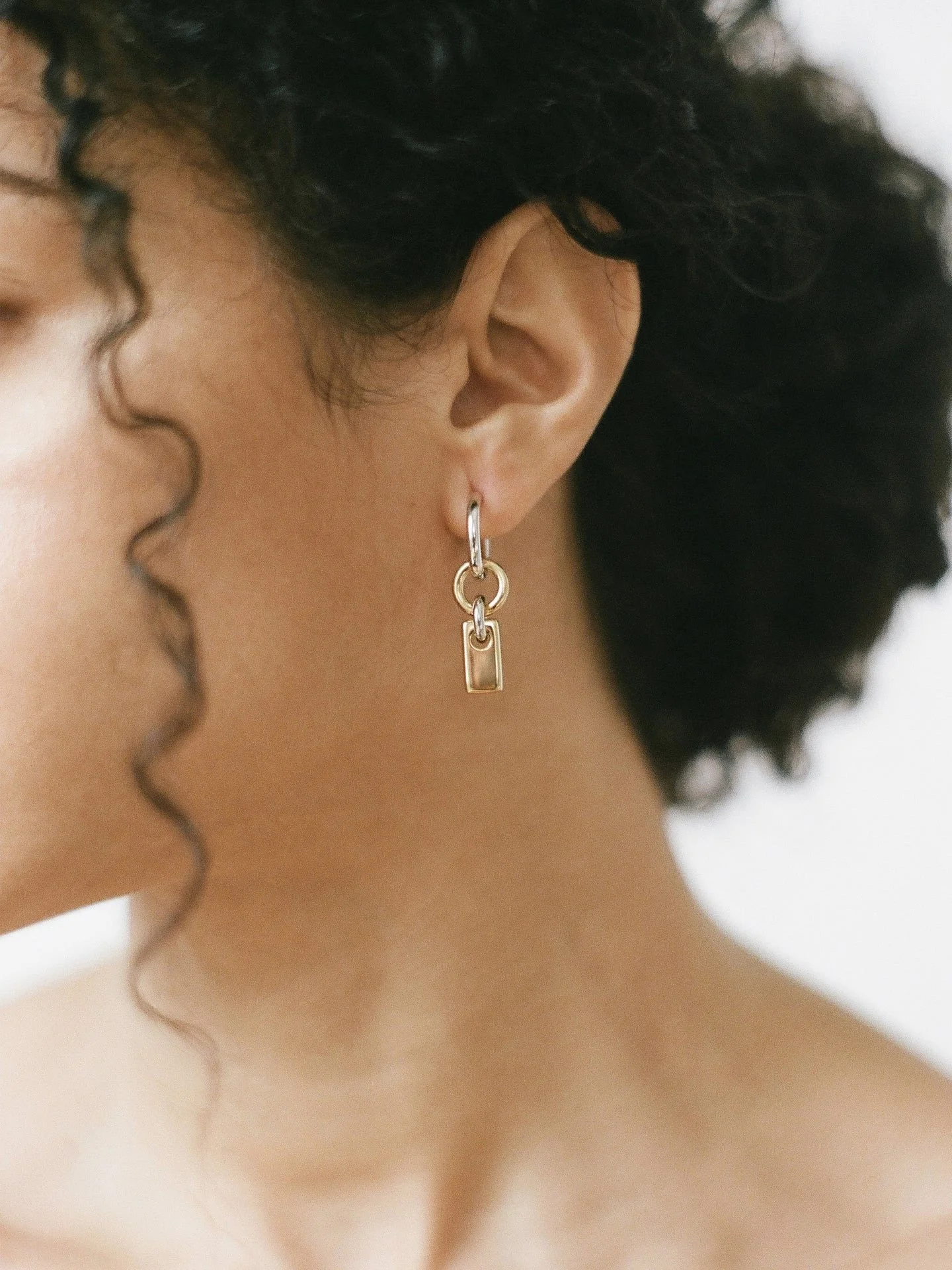
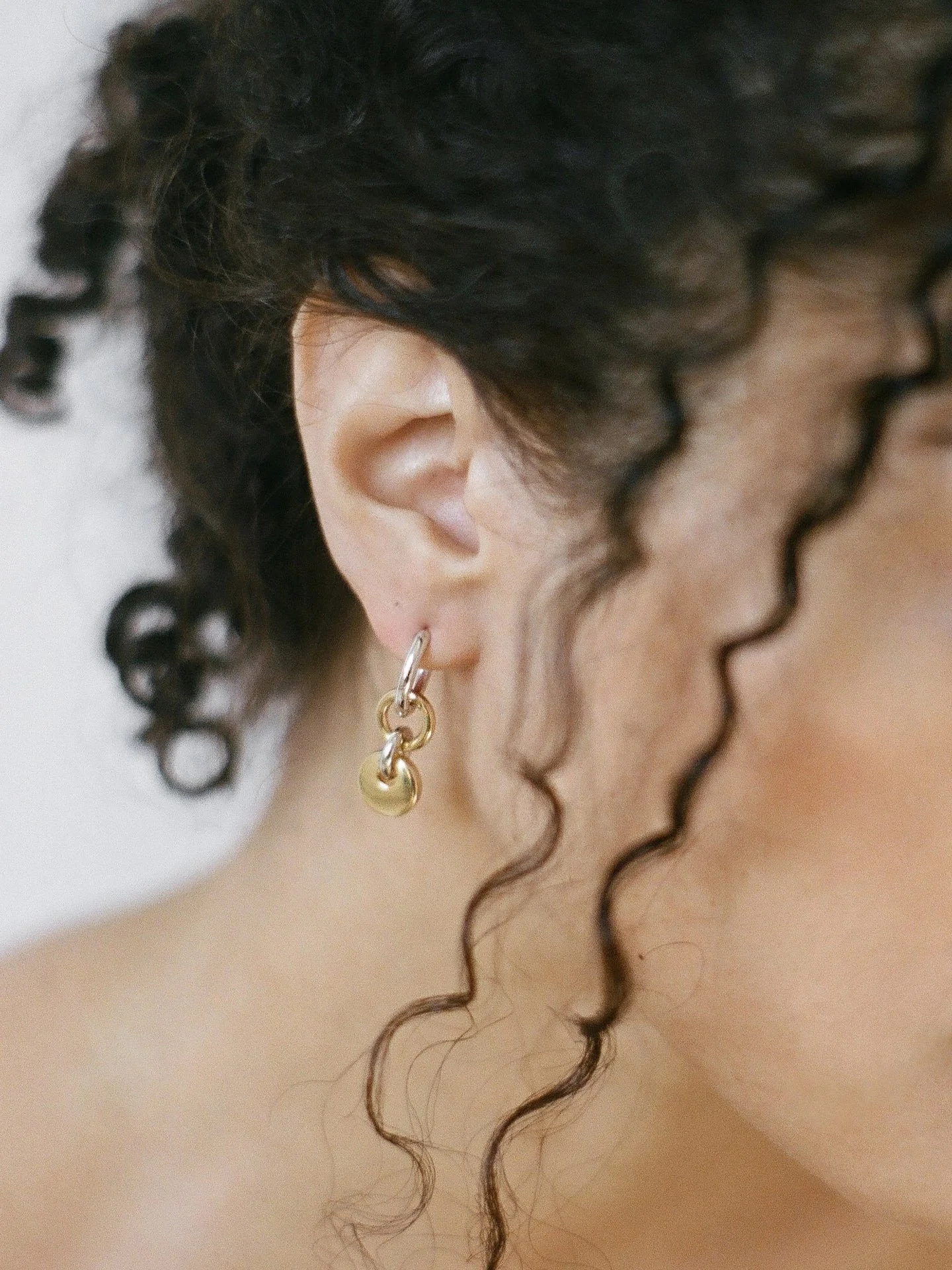
The earrings that had me spiraling. They can be purchased at www.lauralombardi.com. Square pair is "Two Tone Marca Earrings" and the circle pair is "Two Tone Cartolina Earrings"
What is the psychology of the circle versus the square? I didn’t expect to be asking that while shopping. I was trying to pick a new pair of earrings—and somehow ended up questioning which shape is more “feminine” and why that even matters to my style.
It started with two almost identical pairs. Same metal, same size, same vibe…except for one thing: the dangling piece. One was a rectangle, the other a circle. That tiny difference completely froze me. The rectangle felt a little more intimate, edgy, and bold, but still feminine. The circle felt softer, more classic, more “women.” That tiny style dilemma sent me spiraling (in the best way) into the secret lives of shapes: what they mean, how they feel, and how they quietly shape the stories we wear on our bodies.
The Circle
The circle is famously team feminine. I knew this from art school, but I’d never really poked at the why. The circle is often tied to the “circle of life” and to birth specifically. It doesn’t start or stop anywhere; it just keeps going—continuous, cyclical, containing. Psychologically, it gives off vibes of wholeness, protection, and that sense of “things ending but also beginning again.”
It also shows up as a stand-in for the self. People doodle circles when they’re centering or soothing themselves. Think of the ensō, that single, meditative Zen circle painted in one breath of a brushstroke. Then there’s the wedding ring, the full moon, the round Earth seen from above, the loop of the seasons—so many of our everyday symbols are circular and quietly coded as feminine.
What I love about the circle is that it encloses without feeling harsh. It has an inside and an outside, sure, but its boundary is soft—curved, gentle, no sharp corners. In a lot of Indigenous and Eastern traditions, the circle stands for the void things emerge from: the Tao, the Great Mother, the zero. Zero, drawn as a circle, is like a womb made of ink: infinite potential, receptive and cyclical instead of straight and forceful. It doesn’t push; it holds.
The Square
Then there’s the square, often cast as the circle’s opposite—and very much on team masculine. It’s angular, fixed, rational, and clearly drawn. Squares feel human-made: the city grid, the floor plan, the perfect little plot of land. Four corners, four directions, four elements. Where the circle contains, the square defines.
The square is all about organizing and categorizing the world: putting things in boxes, literally and metaphorically. It’s the symbol of earthly order—laws, buildings, institutions. In Jungian language, the square shows up as the ego’s need to structure reality, to take what’s fluid and pin it down. Think architecture, spreadsheets, charts sliced into neat quadrants—that’s square energy in action.
If zero is the soft, circular womb of possibilities, then one is the square’s sharp cousin: a straight line, a little spear of intention. Zero receives; one advances. One says, “Let’s go.”
Why the Circle Gets the Feminine Vote?
So why do so many artists, mystics, and symbol-nerds keep pinning the shape of the circle to the “feminine”? A few reasons come up again and again:
1. Form: curves vs. angles
Circles and arcs echo the curves of the body—the pelvis, the breast, the belly. They read as soft, rounded, nurturing. Angles and straight lines feel sharper, more “hard-edged,” so they often get coded as masculine by contrast.
2. Process: cycles vs. finish lines
Circles hint at cycles: phases, seasons, the idea of returning instead of just arriving. Squares feel more like a destination: the finished room, the completed box, the “I’ve arrived” shape. Across cultures, feminine symbolism tends to be cyclical (menstruation, tides, seasons), while masculine symbolism leans more linear (the quest, the climb, the straight shot from point A to B).
3. Receptivity vs. assertion
The circle is a container. No corners, no front, no back—it just holds. It feels like openness, inclusion, “I can make space for this.” Energetically, it says, “I’m here, I’m available, and I can hold what comes.”
The square is a claim. Clear edges, strong corners, definite boundaries. It stakes out territory: “This is my space; this is where I stand.” It’s about structure, definition, rules, and drawing a line—literally.
4. Unconscious vs. conscious
The circle often gets linked to the unconscious, the dream world, the deep ocean of feelings and instincts. The square is associated with consciousness, reason, and civilization—the part of us that measures, plans, and builds. One is the mystery; the other is the map.
Back to the Earrings… I was basically having a tiny existential crisis over a circle and a rectangle. On the surface, it was just a style choice but underneath, it felt like I was choosing between two different lives: the softer, more containing, cyclical language of the circle versus the sharper, more assertive, directional language of lines and corners.
For a minute, I was sure the circle was the “right” choice. If I wanted to appear more feminine, get a boyfriend, wasn’t the wholesome, elegant, perfectly rounded shape the obvious move? Was I silly to think that a pair of earrings could even hold that power? It felt safe, classic, like it would signal a softer version of me, but I couldn’t ignore the part of me that lives for a little tension and asymmetry—the inner artist who gets bored when things are too neat, too expected, too on-theme.
In the end, I chose the rectangular pair and if you know me at all it wouldn’t surprise you. They read a bit more ‘edgy’ as if they say, “I’m soft, but I also have an opinion.” Choosing them felt less like dressing a character and more like dressing my actual self: feminine, yes, but also creative, slightly off-center, and not afraid of a sharp line or two.