
Living in the Age of Anxiety
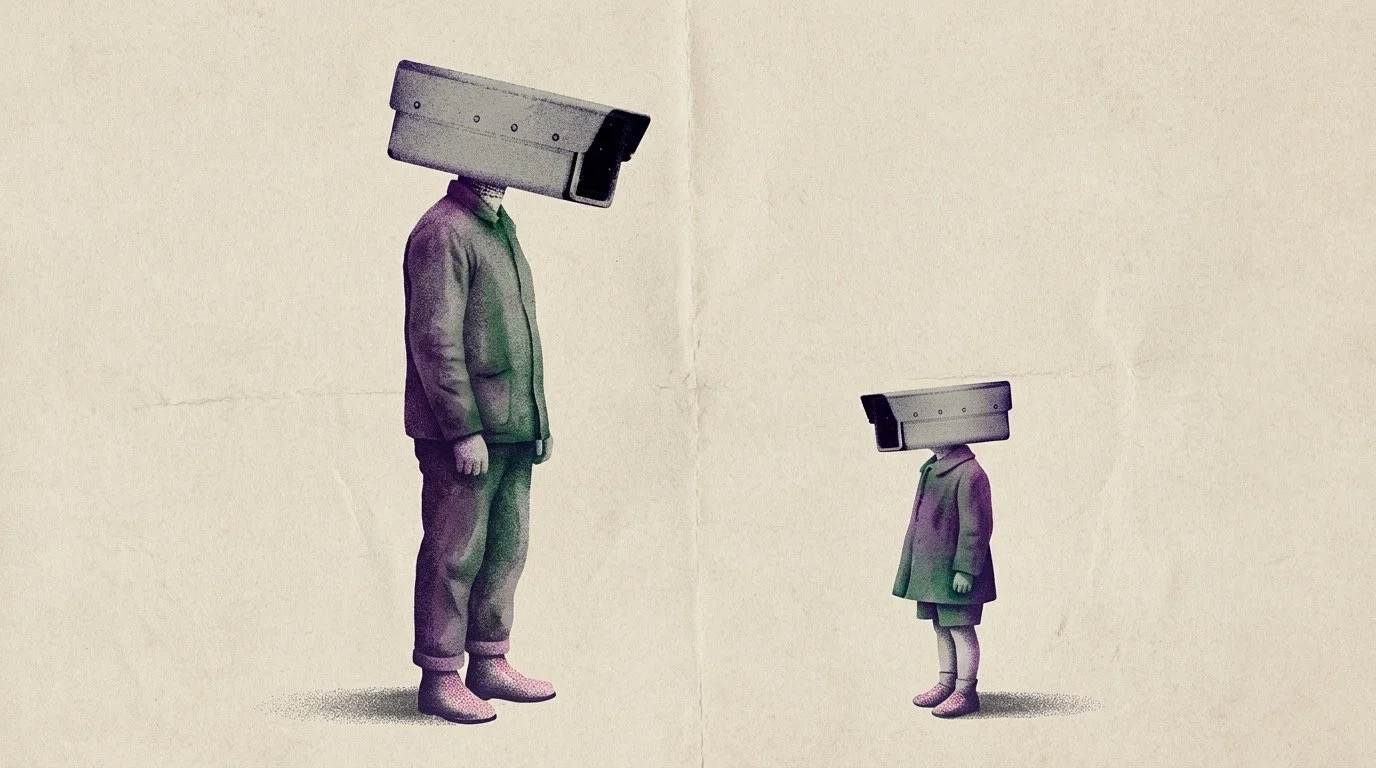
Cyborg Humans made by Perplexity inspired by Julia Wytrazek’s illustration “Cyborg Spy Pigeons”
How neoliberalism manufactures the wounds it sells us the cure for and how the wellness industry is becoming proof.
We are still living in what Marshall McLuhan called the “Age of Anxiety” - a condition he diagnosed in Understanding Media as the inevitable psychological cost of electric media, a world accelerated by technology beyond the mind’s capacity to orient itself. But to fully grasp the texture of this anxiety in the present moment, McLuhan must be read alongside Byung-Chul Han’s Psychopolitics: Neoliberalism and New Technologies of Power to understand how the very culture produced by this age of anxiety has attempted to cure itself using the same mechanisms that have made us sick. As we have shifted from classical liberalism into neoliberalism ( a shift generally traced to the late ‘70s), power no longer operates through walls and prohibitions but through data, desire, and the architecture of the self.
Han argues that we no longer inhabit a purely disciplinary society in Foucault’s sense, governed by external coercion and prohibition. Instead, we live inside a collective technological psychogram - a vast, invisible infrastructure of data in which our desires, anxieties, and behaviors are continuously mapped, predicted, and optimized. The neoliberal regime, Han insists, is a biopolitical regime (Foucault’s Birth of Biopolitics), one that rules not through force but through seduction. Media in this context does not merely inform, it motivates, competes for attention, and feeds its audiences a relentless mythology of self-improvement and peak performance. On the surface, this looks like a remedy for anxiety. Look closer, and it is anxiety’s most refined product - a culture that monetizes the very restlessness it manufactures.
Nowhere is this contradiction more visible than in the contemporary industries of health and fitness. By 2026, health has fully emerged as an economic status symbol, and this is no accident. The same media ecosystem that fragments attention and accelerates burnout also sells us the cure: fitness regimes, cognitive enhancement drugs, cosmetic intervention, biometric self-tracking, and mental optimization repackaged as Wellness. Physical discipline, once the domain of medicine and morality, has been absorbed entirely into the market. The boundary between aesthetics and health technology has dissolved, and what remains is a seamless commercial logic in which anxiety about the body generates billions in revenue. We are ill from the speed, and we are sold the supplements, plastic surgery, IV drips, and health retreat packages.
This is the profound irony at the heart of our moment. The disciplinary society does not merely ignore our anxiety - it has learned to harness it. The hyper-achiever, the hyper-worker, the optimized self: these are not antidotes to the Age of Anxiety. They are its most profitable expressions and all of it has crept into us gradually, unconsciously, through the deep cultural conditioning Han illustrates with his striking metaphor of the mole and the snake. The mole, Han’s symbol of the old disciplinary subject, burrows through fixed tunnels contained, bounded, externally constrained. The snake by contrast “is the neoliberal subject: fluid, self-propelling, endlessly adaptive, but no less captured (Han).” We have been conditioned so thoroughly through advertising, public education, social media, and popular culture - that the imperative to grow, optimize, and compete no longer feels like ideology. It feels like instinct. It has become the grammar of our inner lives, surfacing in cultural norms that celebrate the entrepreneurial visionary and quietly shame the rest.
The body is simply where this logic becomes most intimate and most inescapable. When we treat our own flesh unconsciously as a project to be optimized, we are not resisting economic rationality - we are its most loyal expression. The self has become an enterprise, and the body its primary site of investment and return. What makes this so total, and so difficult to name, is that the master and the slave now share the same skin. We are simultaneously the CEO issuing demands and the exhausted worker who must meet them. The whip has been internalized. Exploitation has been rebranded as self-care, and we have accepted the rebranding gratefully.
The culture of self-care has migrated far beyond bubble baths, breath work, and meditation apps into something that would have seemed extreme even a decade ago. People now structure entire lifestyles around optimizing their biology: meticulously timed protein intake, cold plunge protocols, red light therapy panels in suburban bedrooms, continuous glucose monitors worn by people who do not have diabetes, peptide injections, and supplement stacks that read like pharmacy inventories. Muscle is no longer just aesthetic - it has been rebranded as “the organ of longevity,” a medical imperative, and the gym has become a kind of secular clinic where attendee’s God is the optimized self. This logic has since been franchised. Restore Hyper Wellness, founded in Austin in 2015, is a national chain offering cryotherapy, IV drip therapy, hyperbaric oxygen, and red light therapy under one roof — a retail storefront for biohacking, promising to decrease inflammation, optimize sleep, and help customers meet “the best version of themselves.” It is Han’s psychopolitical imperative made into a strip-mall business model. At the furthest edge of this continuum sits Bryan Johnson, the tech entrepreneur who has constructed perhaps the most literal monument to the neoliberal body-as-enterprise: a rigorous, data-saturated, multi-million dollar daily protocol aimed explicitly at reversing his biological age and ultimately defeating death itself. Johnson does not frame this as vanity. He frames it as the most rational possible allocation of resources- which is precisely Han’s point. The entrepreneurial logic has so thoroughly colonized our relationship with our own bodies that the desire to live forever no longer sounds like hubris. It sounds like good project management. What began as a media-sold imperative to be healthy has quietly metastasized into something far more totalizing- the belief that mortality itself is an optimization problem we simply haven’t solved yet, and that to stop trying is a form of failure.
There is another dimension to this that McLuhan’s framework illuminates with particular force. McLuhan believed the artist was always ahead of the culture - that the truly perceptive mind could read the medium before the masses felt its effects, sensing in advance the new sensory and psychological landscape it would produce. If that is true, then we should pay close attention to what today’s artists are imagining, because the artists of our moment are not merely painters or poets. They are scientists, engineers, and technocrats. Figures like Elon Musk with Neuralink, or Peter Thiel with his investments in life extension and biotechnology, are doing what avant-garde artists have always done- they are projecting the logic of the present into its most extreme future form. And what they are projecting is a body that is no longer merely optimized but fundamentally merged with technology. The transhumanist vision- of neural interfaces, genetic enhancement, and indefinite lifespan- isn’t a departure from the neoliberal body-as-enterprise. It is its logical conclusion. If the self is a startup, then death is simply a problem that hasn’t been adequately funded yet.
What makes this particularly significant, in McLuhan’s terms, is that this vision has not yet fully entered the media mainstream- it remains, for now in the year of 2026, the province of Silicon Valley conferences and speculative biology journals. But that is precisely where McLuhan would direct our attention. The medium always precedes the message it eventually delivers. Biotechnology and AI-assisted medicine are already reframing the body not as something to be healed but as something to be upgraded, pushing past the threshold of necessity into the territory of pure replacement. We are not merely treating illness anymore- we are prototyping a post-human ideal, one in which the boundary between therapy and augmentation, between medicine and vanity, dissolves entirely. The health industry and the technology industry are converging on the same fantasy: a body liberated from biological limitation, infinitely plastic, infinitely improvable. It is the entrepreneurial self taken to its metaphysical extreme and if McLuhan is right that the artist always reflects the times before the times know themselves, then what these technocrats are building in their laboratories today is the culture of tomorrow.
This is where McLuhan and Han converge most powerfully, and where the irony becomes almost unbearable. The programming and social media industries, today’s dominant mediums, do not simply carry messages. They restructure consciousness itself, embedding the entrepreneurial imperative deeper with every scroll, every metric, every algorithmically optimized feed. They cultivate impulsivity over reflection, image over argument, reaction over thought. Where the older technologies of writing and reading trained the mind toward depth and critical distance as the mole was described by Han, the psycho-technological environment of algorithmic media produces what Han describes as mass regression, a population increasingly unable to resist its own stimulation, increasingly unable to tell self-expression from self-promotion, self-care from self-exploitation. We scroll through wellness content in a state of ambient dread and call it health research. We optimize ourselves for a market that will never be satisfied and call it growth. The Age of Anxiety, it turns out, is not a problem neoliberalism is trying to solve. It is the engine neoliberalism runs on and it is very good for business.