
Grammar Is So Last Century: Virtual Virtue Signaling
A 21st-century take on the degradation of grammar.
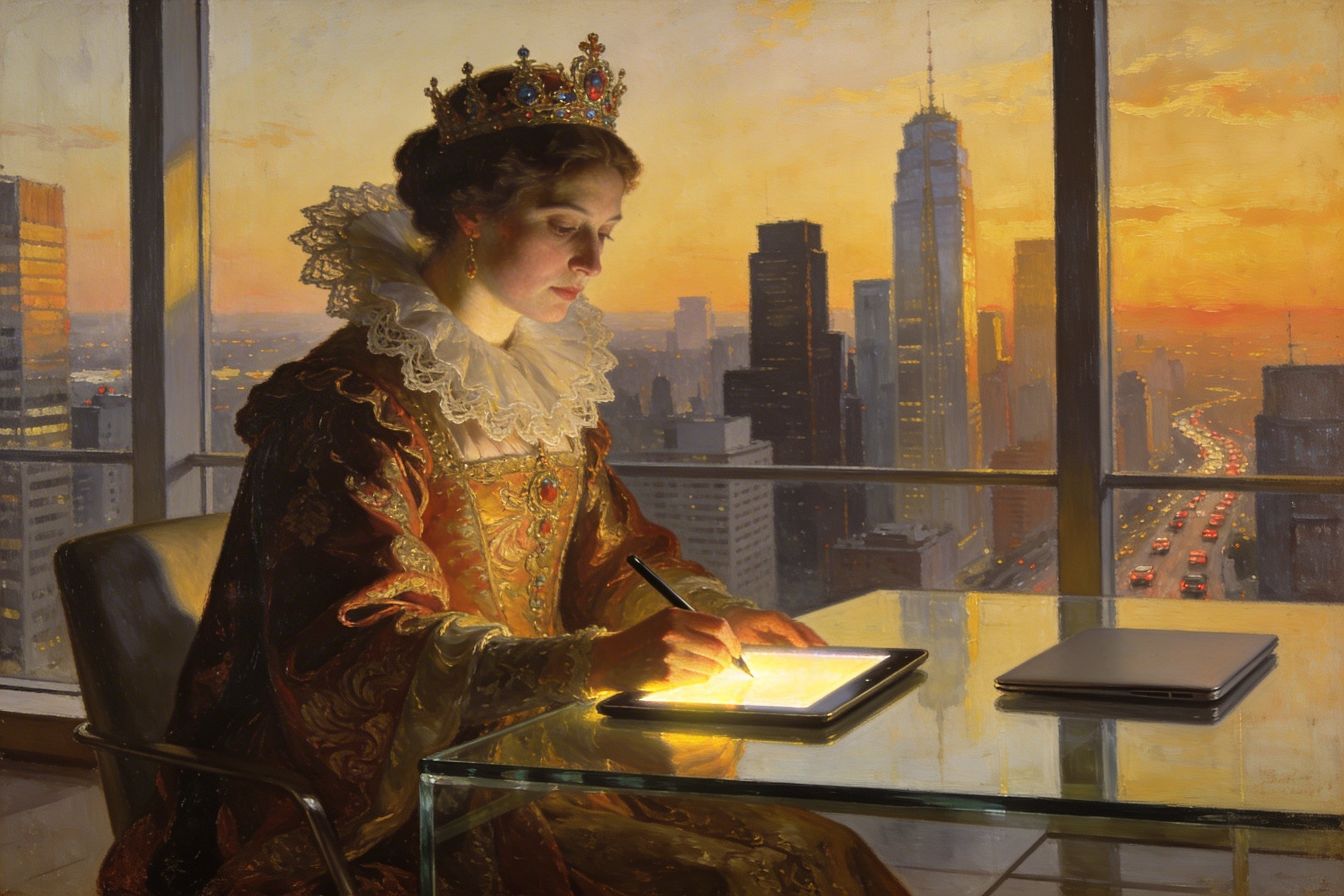
“Lady Writer in the AI Renaissance” This image was generated by Perplexity.AI
I grew up in the suburbs outside Houston, in a place called Katy, a sprawling, master-planned landscape where individuality exists, but is hard to find among the sprawl of sameness and convenience. I was a ’90s kid raised by corporate parents who came of age in the boom years of the ’70s and ’80s. We were comfortably middle class, part of an America that believed education mattered, journalism was credible, and success meant doing well on a written exam.
Grammar wasn’t optional. It was enforced.
My teachers treated punctuation like law. Commas, semicolons, colons—there were right answers, and they marked you in red when you got them wrong.
Those Who Reject Grammar
Fast-forward to 2026…I’m in Austin, writing this on a MacBook, watching grammar slide into nostalgia somewhere between VHS tapes and landlines.
Scroll through Substack and you’ll see it everywhere: lowercase essays, sentence fragments, deliberately messy prose that reads like thought dumped straight onto the page. This isn’t laziness. It’s performance. A signal: this wasn’t written by a machine.
In a world where AI can generate flawless, polished writing in seconds, imperfection has become desirable. Clean prose feels synthetic. Messy writing feels human. What we’re watching isn’t just a stylistic shift—it’s a cultural one.
Rejecting grammar has become a kind of virtual virtue signal.
Letters like these are rare and that’s what makes them matter even more.
Grammar Was Once Proof of Thought
There was a time when grammar signaled intelligence or at least effort. A clean sentence suggested a clear mind. A well-structured paragraph implied discipline, intention, respect for the reader.
That relationship is breaking down.
Now, the more polished the writing, the more suspicion it invites. Even the em dash “—” once a stylistic flourish has been turned into evidence. Use it too often, and readers assume AI was involved. Precision no longer proves authorship, it undermines it.
The Machine Writes Better Than You
It’s the uncomfortable truth: the machine is better at grammar than you.
It doesn’t forget commas. It doesn’t misuse semicolons. It doesn’t get tired, distracted, or sloppy. It produces clean, structured, technically perfect prose on demand.
So what’s left for the human writer?
Error. Texture. Friction. Poetry.
A typo becomes a fingerprint. A fragmented sentence becomes a signature. Writers/Artists are learning consciously or not that the easiest way to prove they exist is to sound slightly off.
Sloppiness as Identity
This isn’t just about aesthetics. It’s about identity.
We’ve entered a moment where correctness feels artificial and imperfection feels real. So the artist leans into it. They lowercase. They fragment. They abandon structure. Not because they can’t write well but because writing well now carries in-authenticity & suspicion.
It’s the same cultural drift that took us from suits to sweatpants, from formality to comfort, from effort to ease. But language isn’t just clothing. It’s cognition.
When we lower the standard of expression, we risk lowering the standard of thought.
Or Maybe This Is Just What Language Does
Grammar has never truly been fixed. It’s a system that hardened over time shaped by printers, standardized by dictionaries, enforced by institutions.
What we call “proper English” is just a long-standing agreement and agreements change.
Language loosens. Rules get ignored. New forms emerge. This has happened before, and it will happen again. The difference now is speed and the presence of machines that can outperform us.
Outsourcing the Mind
Some people reject AI. Ithers use it constantly and are starting to forget how to function without it.
Spell-check, autocomplete, AI writing tools—we lean on them for everything from emails to essays. They make life easier. They also make us lazier. Where answers are a tempting text away.
Students struggle to write. Spelling deteriorates. Handwriting disappears. Ask someone to write a page without assistance, and many stall out. At some point, this stops being convenience and starts becoming dependence.
Because writing isn’t just output. It’s thinking.
If you outsource the sentence, you start outsourcing the idea.
Communication Is Collapsing
Look at how we communicate now.
Text messages. Emojis. One-line replies. Fragments.
Conversations that once took pages now happen in bursts. A phone call feels intrusive. A paragraph feels excessive. We write the way we scroll: fast, compressed, frictionless.
Grammar, in that environment, feels like drag. Not a tool—an obstacle.
McLuhan Saw It Coming
Marshall McLuhan warned that electric media would reshape language—that once communication becomes instantaneous and sensory, words begin to lose their dominance.
He was early. He wasn’t wrong.
We now live in a visual, accelerated culture where images, videos, and AI-generated outputs replace slower, text-based thinking.
Literacy isn’t disappearing—but it’s being deprioritized.
And grammar goes with it.
Grammar Becomes a Luxury
Grammar won’t vanish. It will become selective.
A signal used by the Artists who understand it well enough to manipulate it. A tool of precision for those who still care. A kind of intellectual luxury.
Everyone else will default to speed.
Shorter. Faster. Looser. Good enough.
The Split
We’re heading toward a split…One group will use AI to extend their thinking, sharpening it, refining it, staying engaged in the process. The other will hand it over completely. Writing, thinking, structuring ideas will all become outsourced.
The difference won’t just show up in grammar. It will show up in clarity, depth, and the ability to form original thought.
The Real Risk
The risk isn’t that grammar disappears.
The risk is that we lose the ability to tell the difference between a well-formed idea and a generated one. That we confuse fluency with understanding. That we trade effort for ease so completely that thinking itself starts to atrophy.
Because once writing becomes effortless, it also becomes disposable.
The Next Chapter
Maybe this isn’t the end of grammar. Maybe it’s a stress test, a phase where the rules collapse and writers have to decide what voice they’ll keep.
Imitating a machine or resisting one.
The Artist won’t abandon grammar completely, or cling to it rigidly. They’ll be the ones who understand it and then bend it with intent.